The numbers are the reason roof rejuvenation is worth a serious look. For an existing roofing contractor, it can add a maintenance option between repair and replacement. For someone starting from scratch, it can become a focused exterior-maintenance service with a manageable equipment list, clear material usage, and strong gross-margin potential when the jobs are screened and priced responsibly.
The customer is not comparing rejuvenation to nothing in the abstract. They are often comparing it to a roof replacement that could be $10,000, $20,000, $40,000, or more depending on the house and market. A maintenance job is a much smaller ticket. If the roof is a fit, that smaller ticket can still leave the operator with healthy margin while giving the homeowner a real alternative to replacing too early.
That opportunity comes with a boundary. This is not a license to spray every roof in town. Bad roofs do not become good business because the spreadsheet looks nice. The roof still has to be asphalt shingle, dry, intact, and in the maintenance window.
Product Cost Per Roofing Square
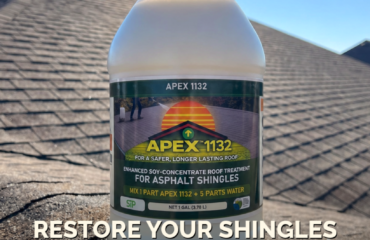
One roofing square is 100 square feet of roof area. APEX 1132 is mixed 1 part product with 5 parts water, so 1 gallon of concentrate makes about 6 gallons of finished spray. The finished spray is applied at about 1 gallon per 200 square feet. That means 1 gallon of concentrate covers about 1,200 square feet, or about 12 roofing squares.
If someone is starting small and buying through Amazon at roughly $200 per gallon, the product cost is about $16.67 per roofing square. Round it to about $17 per square. For a 20-square house, that is about $333 of product.
Larger-volume buying changes the picture. With 55-gallon drums or 275-gallon totes, material cost can drop to about $8 to $9 per roofing square. On the same 20-square house, product cost falls closer to $160 to $180.
| Scenario | Product Cost Per Square | Product Cost On 20 Squares |
|---|---|---|
| Small-volume buying | About $17 | About $340 |
| Larger-volume buying | About $8-$9 | About $160-$180 |
That spread gives new operators room to test the market without committing to large volume, while established operators can improve margin as demand becomes more predictable.
What The Job Can Gross
Contractor-treated jobs often land somewhere around $1,000 to $4,000, depending on roof size, pitch, access, prep, local market, travel, documentation, and how the service is packaged. The important thing is to scale the example honestly. A $4,000 job is probably not the same roof as a $1,000 job. It is likely larger, steeper, harder to access, in a higher-value market, or some combination of those.
| Example Job | Small-Volume Product Cost | Larger-Volume Product Cost | Sale Price | Revenue After Product, Small-Volume | Revenue After Product, Larger-Volume |
|---|---|---|---|---|---|
| 15-square roof | About $255 | About $135 | $1,000 | About $745 | About $865 |
| 30-square roof | About $510 | About $270 | $2,000 | About $1,490 | About $1,730 |
| 40-square roof | About $680 | About $360 | $4,000 | About $3,320 | About $3,640 |
That is not net profit. Labor, insurance, travel, taxes, marketing, equipment, callbacks, and weather delays are real. But product cost usually is not the part that breaks the model. Even in the small-volume scenario, material cost leaves room to build a real service around inspection, application, documentation, and judgment.
What Homeowners Should Know
The homeowner math should be simple enough to explain without a spreadsheet. A typical asphalt shingle roof is often discussed around a 25-year service life. If replacement is a $25,000 decision and that roof lasts 25 years, the roof effectively costs about $1,000 per year over its life. If maintenance helps add about 5 useful years, that is roughly $5,000 of value from delaying replacement.
We are not the spray applicators, and every roof and market is different, but many $25,000 roofs are likely to cost somewhere around $2,000 to $3,000 for a professional rejuvenation treatment. If the roof is a fit, that math can work very well for the homeowner. They may be spending a few thousand dollars to preserve a roof that would cost many times more to replace too early. The contractor still has to explain the value honestly: not “this replaces your roof,” but “this may help you get more useful life from a roof that is still worth maintaining.”
Why Existing Contractors Have An Advantage
Existing contractors may already have trucks, ladders, roof access experience, insurance, local credibility, estimating habits, and crews who understand roof condition. That does not make rejuvenation automatic, but it removes a lot of startup friction.
The best fit is a contractor who wants another honest answer besides “repair it” or “replace it.” If the roof is failed, repair or replacement is still the right recommendation. If the roof has room for maintenance, rejuvenation gives you something useful to offer. That can build trust because the answer feels tied to the roof, not just the most expensive service you sell.
There is also a lead-flow advantage. Roofers already talk to homeowners worried about roof age. Some are ready for replacement. Some are not. Rejuvenation lets you serve the second group without forcing a replacement conversation too early. It can turn “call us in a few years” into revenue today and a stronger relationship for the eventual replacement.
Starting From Scratch
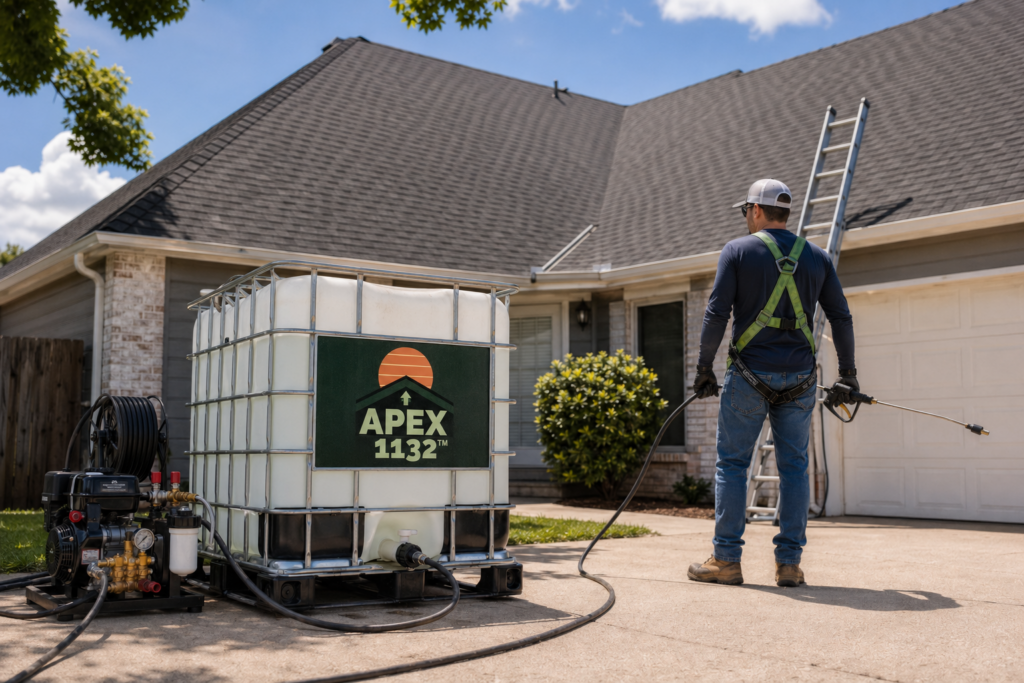
Anyone starting from scratch needs to handle local rules, licensing, insurance, taxes, safety requirements, and business structure. Those details vary. The basic operating path, though, is straightforward: buy material, buy a sprayer, get safety equipment, learn the application, and build a way to find and screen customers.
Starting small can be reasonable. Buying through Amazon gives a new operator a way to test the process without a large-volume commitment or a sales relationship. Some people have been burned by other roof-treatment companies and want to learn quietly before scaling. That is understandable.
We generally recommend this backpack sprayer as a starting point: https://www.amazon.com/dp/B09TB8NSZY. The brand matters less than the result. The sprayer needs to apply evenly, and the operator needs to verify coverage around 200 square feet per finished gallon. If coverage is wrong, both the economics and the job quality get messy.
Safety equipment is not optional. Roof work deserves respect, and each operator has to decide what is appropriate for their roofs, local requirements, and risk tolerance. A good margin does not matter if the job is unsafe.
Startup Cost And Break-Even
Here is a rough from-scratch example:
| Startup Item | Rough Cost |
|---|---|
| Product for first 15-square house | About $300 |
| Backpack sprayer | About $300 |
| Safety equipment | About $200 |
| Bare-bones branding and advertising materials | About $100 |
| Insurance | About $1,000-$5,000 |
On the low side, that is about $2,000 to get moving. On the high side, with expensive insurance, it is about $6,000. Those are rough numbers, and every operator needs to check their own market.
Now take a tough version. The operator buys product at small-volume pricing, sells each 15-square job for $1,000, and has $5,000 insurance. Product is about $300 per job, leaving about $700 before labor and other overhead. With about $5,600 of fixed startup cost for sprayer, safety equipment, branding, and insurance, it takes roughly 8 houses to break even. At $2,000 jobs, the payback can drop to around 4 houses. At $4,000 jobs, it can happen faster.
No operator is guaranteed to succeed, but the unit economics are strong enough to make the opportunity real. The bigger risks are customer acquisition, roof screening, safety, local compliance, pricing, and execution quality.
What Can Hurt The Math
The business can look great in a spreadsheet and still get ugly in the field. Steep roofs take longer and may require more safety planning. High roofs, difficult access, heavy debris, travel time, rescheduling for weather, overspray protection, and customer education all affect margin. A 20-square roof with easy access is not the same job as a 20-square roof with steep pitches, landscaping everywhere, and nowhere to park.
Pricing too low can also hurt the business. If an operator treats this like a cheap spray job, they may win work and still build a weak company. The customer is paying for inspection, application, documentation, safety, and judgment. The product is part of the service, but the operator is responsible for the outcome.
The biggest edge case is a roof that should not be treated. If the roof is leaking, missing shingles, structurally compromised, or past the maintenance window, the correct answer is repair or replacement. Taking that job anyway can turn a profitable service into an expensive complaint.
The Practical Takeaway
Roof rejuvenation can make strong business sense because product cost per job is relatively low compared with what homeowners may pay for the service and what they are trying to avoid in replacement cost. For an existing contractor, it can be a practical maintenance lane with real revenue potential. For a new operator, it can be a focused business with a reachable break-even point.
The opportunity is real, but the operator still has to earn it. Screen the roof, price the work correctly, apply consistently, work safely, and document the job. That is what turns good unit economics into a service people trust.