For a homeowner, the numbers behind DIY roof rejuvenation can be attractive. If the roof passes the condition check and the work can be done safely, the product cost may be a small fraction of what a contractor would charge and an even smaller fraction of a roof replacement. That is the opportunity.
There is also a serious warning attached to it: this is still roof work. A good spreadsheet does not make a steep roof safer. Ladders, loose granules, heat, wind, overspray, awkward rooflines, and two-story drops don’t care that the math looked good. If the roof is steep, high, wet, damaged, or uncomfortable to access, the better financial decision may be hiring a professional or stopping the project.
The Product Math
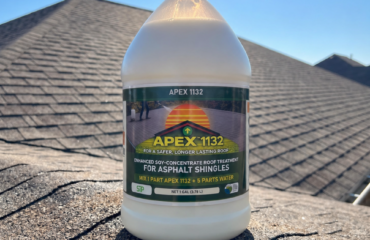
APEX 1132 is mixed 1 part product with 5 parts water. One gallon of concentrate makes about 6 gallons of finished spray. The finished spray is applied at about 1 gallon per 200 square feet. Since 1 roofing square is 100 square feet, 1 gallon of concentrate treats about 1,200 square feet, or about 12 roofing squares.
If a homeowner buys small quantities online at roughly $200 per gallon, the product used works out to about $16.67 per roofing square. Rounding that to about $17 per square makes the math easy.
| Roof Size | Concentrate Used | Product Cost Used At $200/Gal |
|---|---|---|
| 15 squares | About 1.25 gallons | About $250 |
| 20 squares | About 1.67 gallons | About $333 |
| 30 squares | About 2.5 gallons | About $500 |
That table shows product used, not always what you have to buy. If product is sold by the whole gallon, a 15-square or 20-square roof may still require buying 2 gallons, or about $400 of product. A 30-square roof may require buying 3 gallons, or about $600. Leftover product may be useful later if stored properly, but the cash outlay matters when planning the first job.
Why The Value Gets Attention
The appeal is easy to see. A homeowner may be able to buy about $400 of product and treat a roof that a contractor might charge $2,000 to $3,000 to handle, depending on size, pitch, access, market, and job conditions. That doesn’t mean the contractor price is unfair. A contractor is charging for labor, equipment, safety, insurance, experience, scheduling, documentation, and taking on the work. Those things have real value.
For a capable homeowner with a simple, safe roof, though, DIY can save real money. On a 20-square roof, the product used may be roughly $333 and the product purchase may be around $400. Even after adding a sprayer and safety equipment, the first project may still be far below a contractor-applied treatment.
The replacement comparison is where the math becomes even more meaningful. A roof replacement can be $10,000, $15,000, $20,000, $30,000, or more depending on the home and market. If a few hundred dollars of product helps delay that decision responsibly, the financial logic is hard to ignore.
The Real First-Project Cost
Product is not the only cost. A homeowner may also need a sprayer, protective equipment, measuring supplies, cleaning tools, and possibly ladder or access equipment. We generally recommend this backpack sprayer as a starting point: https://www.amazon.com/dp/B09TB8NSZY. The exact sprayer matters less than the result. It needs to apply evenly, and coverage should be close to 200 square feet per finished gallon.
Here is a rough first-project budget for someone starting from scratch:
| Item | Rough Cost |
|---|---|
| Product for a 15-25 square roof | About $400 |
| Backpack sprayer | About $300 |
| Basic safety equipment | About $200 |
| Miscellaneous prep supplies | About $50-$100 |
That puts a first DIY project around $950 to $1,000 if the homeowner has to buy everything. If they already own some gear, the number will be lower. If the roof is larger, product cost goes up. If the roof is unsafe and needs professional access, the DIY math should stop right there.
Break-Even Against Replacement
A simple way to think about break-even is to ask how much useful time the treatment needs to help buy before the decision makes sense. If a homeowner spends $400 to $1,000 on DIY rejuvenation and avoids replacing too early, the break-even window can be short.
Take a $1,000 first-project DIY cost on a roof that would cost $15,000 to replace. If treatment helps delay replacement by 2 years, that is about $500 per year to postpone a $15,000 project. If it helps for 5 years, that is about $200 per year. If the homeowner only spends $400 to $600 because they already have equipment, the math gets stronger.
APEX 1132 is generally discussed around a 5 to 6 year maintenance expectation before another treatment may be considered, assuming the roof remains in good condition and normal conditions cooperate. That is a reasonable maintenance expectation, not a guarantee. Roofs live outside. Storms, falling limbs, bad flashing, hidden damage, poor ventilation, and installation problems can change the outcome.
Selling The House
DIY economics can also matter when selling a home. Roofs make buyers and sellers nervous, and an older roof can become a major inspection issue. If the roof is older but not failing, spending a few hundred dollars on product and doing real maintenance may be more attractive than replacing the entire roof before listing.
This needs to be handled honestly. If the roof is failing, don’t treat it and pretend it is fine. If it’s in good, but aging, condition, rejuvenation can help the roof present and perform better because the shingles were actually maintained. Keep documentation: before photos, product information, date, mix ratio, approximate coverage, and after photos. Don’t call it a new roof. Say what happened.
The Practical Takeaway
The DIY economics can be excellent. A homeowner may spend about $400 of product to do work that could cost $2,000 to $3,000 through a contractor, while the replacement alternative may be many times larger. That is a real opportunity.
The roof still has to qualify, and the homeowner still has to be safe. If the roof is steep, high, wet, damaged, leaking, or uncomfortable to access, the best economic decision may be hiring someone or walking away. Saving money is good. Taking a roof risk you are not equipped to manage is a bad trade.