Roof rejuvenation is still new enough that a lot of people don’t know what to do with it. Homeowners hear the phrase and wonder if it’s another too-good-to-be-true roof pitch. Contractors hear it and wonder whether it belongs next to repair and replacement or whether it’s going to confuse customers. Both reactions make sense. Roofs are expensive, most people can’t inspect their own roof very well from the ground, and the roofing world has seen plenty of big promises over the years.
This series is meant to make the category easier to understand without turning it into a sales script. We’ll look at why asphalt shingles age, what a rejuvenator is supposed to do, what it can’t do, when replacement is still the right answer, and what a proper application should look like. The goal is to put roof rejuvenation in the right lane: maintenance for asphalt shingle roofs that pass a real condition check.
Most people already understand this idea when they’re talking about a car. You don’t wait for the engine to seize before changing the oil. You don’t wait until the tires are bald before paying attention. We’ve all seen cars that are tired at 100,000 miles because they went without much maintenance, and we’ve all seen well-maintained vehicles still running past 300,000. Maintenance doesn’t make anything last forever, but it can help an expensive asset perform better for longer. Roofs aren’t cars, but the maintenance logic is familiar.
That way of thinking has been missing from a lot of roof conversations. Many asphalt shingle roofs are installed, watched from the driveway, and then replaced when the roof gets bad enough that nobody has many choices left. Sometimes that’s because the roof truly has reached the end. Other times, the shingles had life left and nobody talked about maintenance soon enough.
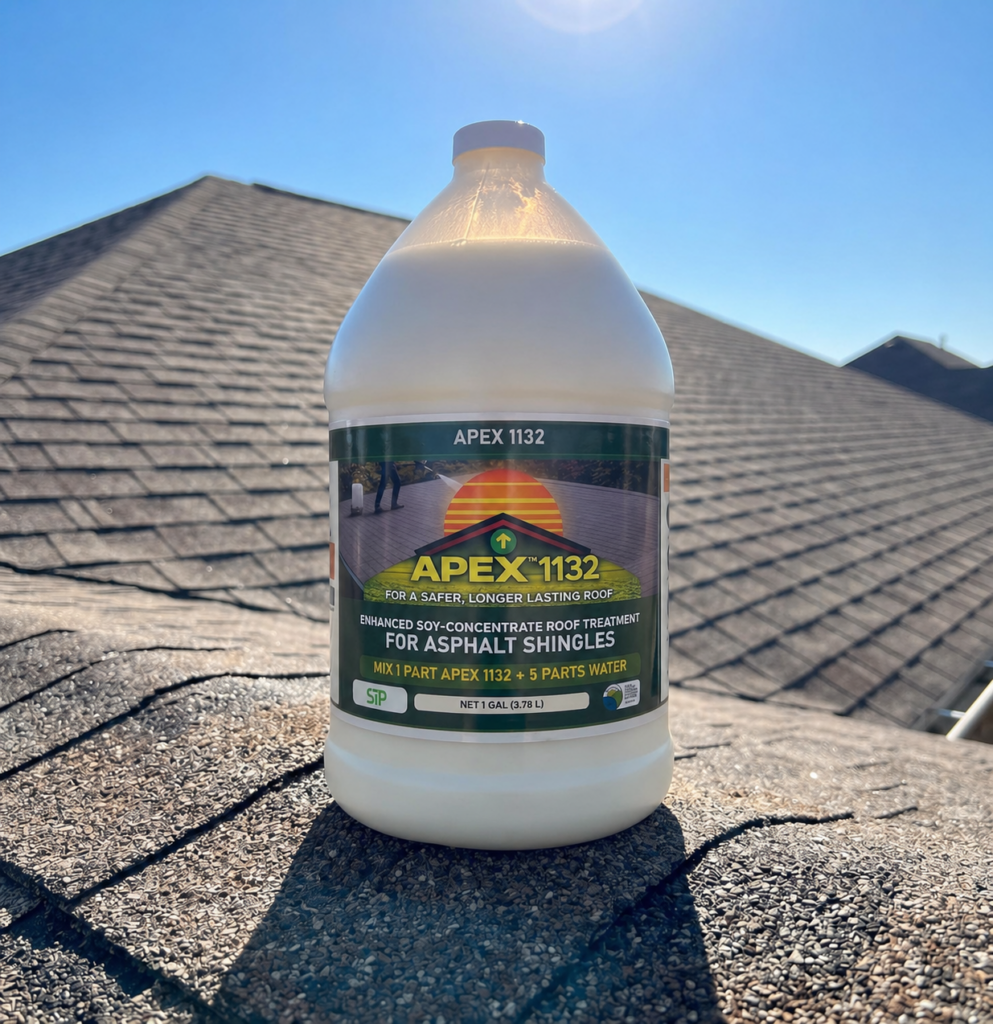
APEX 1132 fits into that maintenance conversation as a soy-derived treatment developed for asphalt shingles. It does not replace missing shingles, rebuild rotten decking, fix bad flashing, or turn storm damage into ordinary wear. Its role is narrower and more useful than that: help improve shingle flexibility, grit retention, and related performance on roofs that are still sound enough to maintain.
The economics are part of the reason this matters. Roof replacement can easily become a five-figure project, and in many cases it can be much more than that. If a qualifying asphalt shingle roof can be maintained for several more useful years before replacement, homeowners have more breathing room and contractors have a responsible option between “patch it” and “tear it off.”
We’ll keep coming back to the same practical filter throughout the series: is the roof aging, or is it failing? If it’s failing, the roof needs repair, replacement, or a closer inspection. If it is just wearing down with age, rejuvenation may be worth evaluating. That simple difference keeps the category honest.
A Note From The Author
I’m Michael Forrester, one of the inventors of this technology and a co-founder of SoyLei. I’m putting this series together because these are the kinds of questions I would care about if I were a homeowner looking at an aging roof or a contractor trying to decide whether roof rejuvenation belongs in my business.
I enjoy talking about the product, the chemistry, the application process, and where this technology fits in the real world. If you have questions, you’re always welcome to reach out by email, through the website form, or by calling me directly. I’m easy to reach, and I genuinely enjoy discussing this technology.